Home / Platform

The ThreatLark platform

Every capability, in depth: from the first sweep of an address range to a prioritized, exportable report, all in one self-hosted console.

Discovery Scan

Find every live host, however large the range

Discovery Scan is the front of the funnel: sweep a range into a named group, then point the vulnerability, attack-surface or OT/IoT scanners at that same group.

5,000default packets per second, adjustable
T0-T5Timing templates
∞no range-size limit
  • Uses ICMP echo, TCP SYN/ACK to common ports, and ARP on local segments, with no port scan
  • Accepts single IPs, CIDR ranges, octet ranges, comma lists and hostnames
  • No cap on range size. A /11 (roughly two million addresses) is documented as tested; larger ranges simply take proportionally longer
  • Targets are processed in chunks so the progress bar reflects real completed work, and a sweep can be paused or stopped at any time
  • Appends newly found hosts to a named target group and never removes known ones
  • Passive OS/device guess (reply TTL, ARP MAC vendor) and reverse-DNS hostnames, with an “OS detection only” mode for existing groups
  • A proxy-ARP / wildcard-responder guard flags implausibly dense results so phantom hosts do not pollute a group
Discovery Scan flowTarget ranges are swept with nmap host discovery, and live hosts are appended to a named target group. TARGET RANGES 10.0.0.0/11 192.168.1.0/24 172.30.1.1-50 plc-01.plant.lan CIDR, ranges, lists, hostnames no range-size cap HOST DISCOVERY ICMP · TCP SYN/ACK · ARP tunable rate, timing, retries NAMED TARGET GROUP 10.0.4.12Linux/Unix 10.0.4.31Windows 10.0.9.200Network 172.30.1.8Linux/Unix + new hosts… hosts are appended, never removed
Illustration of the Discovery Scan workflow. Addresses are examples.
Attack Surface Management

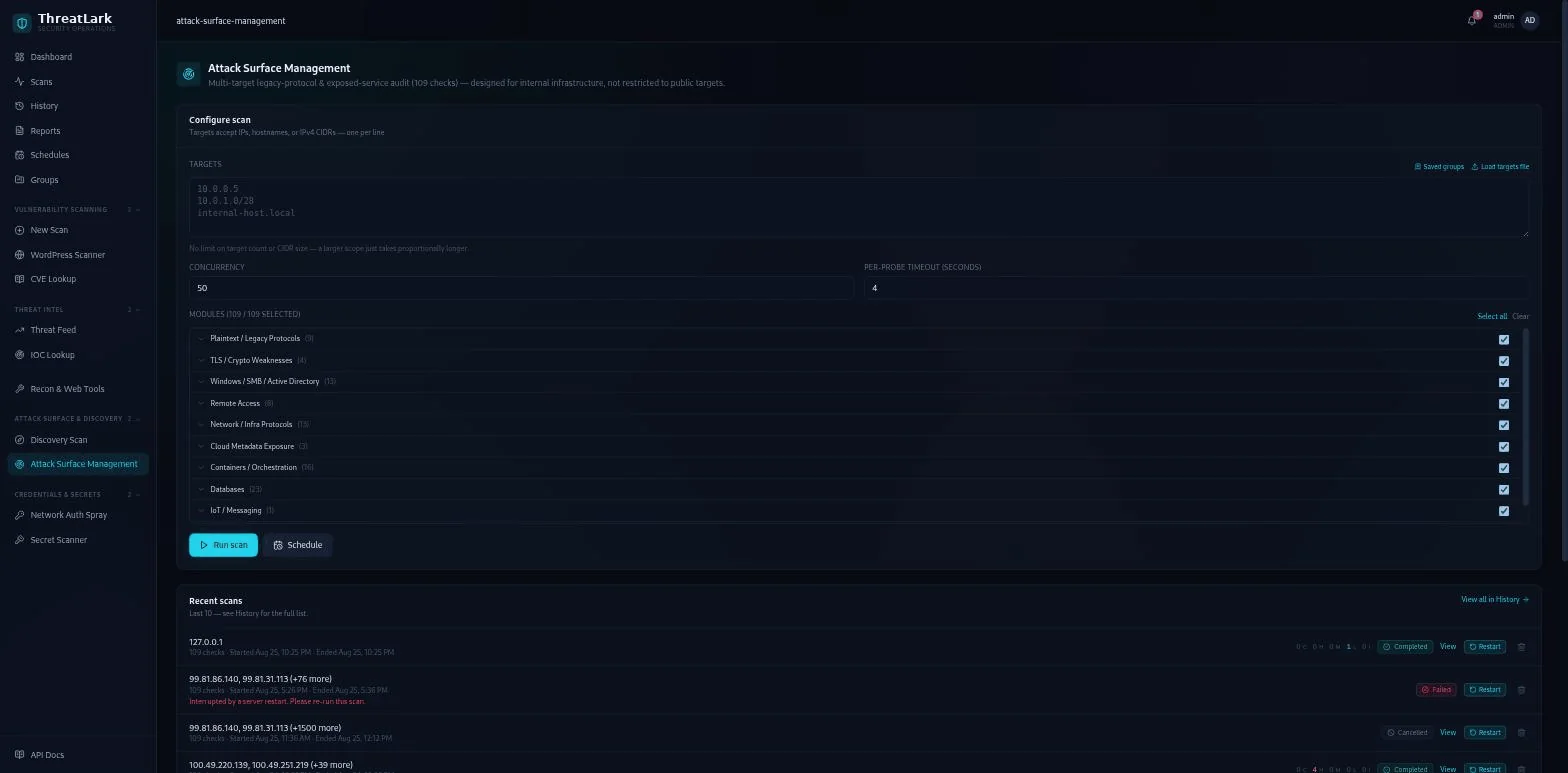
130+ checks for exposed services and legacy protocols

A purpose-built, read-only check engine for internal infrastructure (not restricted to public targets) that maps results straight onto ThreatLark findings.

  • Ten module groups; toggle whole groups or individual checks
  • Targets as IPs, hostnames or IPv4 CIDRs with no target-count or CIDR-size cap; concurrency of 1-100 and a per-probe timeout of up to 15 seconds
  • Real, streamed progress: checks run in groups, and the progress bar reflects completed work polled every two seconds
  • Every scan belongs to a named target group, so repeated audits build up coverage over time
  • An explicit authorization acknowledgement is required before any scan starts
threatlark / attack-surface-management
ThreatLark Attack Surface Management pageExpand
The Attack Surface Management page

What it checks

Module groupRepresentative checks
Plaintext / legacy protocolsTelnet, FTP, Finger, rlogin/rsh/rexec, plaintext POP3/IMAP/SMTP, TFTP, HTTP Basic Auth over plaintext
TLS / crypto weaknessesTLS 1.0/1.1, SSLv2, SSLv3, weak cipher suites
Windows / SMB / ADSMBv1 and signing, NTLMv1 downgrade, SMB shares, AS-REP roasting, Kerberoastable SPNs, AD CS web enrollment, WinRM
Remote accessLegacy SSH algorithms, RDP without NLA, VNC, X11, RADIUS, TACACS+, IKEv1 aggressive mode
Network / infra protocolsSNMP v1/v2c, IPMI/BMC, SIP, LLMNR, WPAD, BGP, DNS zone transfer, open resolvers, NTP mode 6
Cloud metadataAWS IMDSv1, GCP and Azure metadata service reachability
Containers / orchestrationDocker API, Kubernetes API and kubelet, etcd, Consul, Nomad, Portainer, registries
DatabasesRedis, MongoDB, Elasticsearch, PostgreSQL trust auth, MySQL, Kafka, ClickHouse, MinIO, and more
IoT / messagingUnauthenticated MQTT and NATS brokers
Dev tools & admin panelsJenkins, Grafana, Spring Boot Actuator, Tomcat Manager, exposed .git and secret files, Swagger/OpenAPI
OT / IoT Exposure

64 industrial and IoT protocols, probed read-only

Most OT and IoT protocols are unauthenticated by design, so a reachable port is itself the finding. ThreatLark probes for them without ever touching the process.

64protocol checks
20 / 36 / 8critical / high / medium
30checks that include UDP ports (optional pass)
  • Seven groups: Internet-exposed ICS, Core ICS/SCADA, PLC/vendor engineering, building automation, energy/metering/traffic, IoT/IIoT, and cameras/SCADA apps
  • Includes Modbus/TCP, Siemens S7comm, DNP3, EtherNet/IP, IEC 60870-5-104, OPC UA, BACnet/IP, PROFINET, CODESYS, Omron FINS, Beckhoff ADS, KNXnet/IP, MQTT, CoAP, RTSP and more
  • Port detection plus protocol-level verification: one safe, read-only handshake or identify request per protocol, kept with the raw reply as evidence, so an open port 8000 is not reported as a Hikvision SDK unless it answers like one
  • Data-altering, DoS and brute-force scripts are deliberately excluded; only safe stock scripts enrich findings
  • Optional UDP pass (BACnet, DNP3, KNX, CoAP, DDS and others), per-host timeout (default 120 s), targets as IPs, CIDRs, ranges or hostnames
  • Findings can be re-tested later to confirm an exposure is fixed; ambiguous results are reported as inconclusive rather than closed
  • Remediation guidance centres on segmentation, jump hosts and restricting access, not on patching protocols that have no authentication to fix

Internet-exposed ICS18

  • Siemens S7comm
  • Modbus/TCP
  • DNP3
  • EtherNet/IP
  • IEC 60870-5-104
  • Omron FINS
  • OPC UA
  • BACnet/IP

Core ICS / SCADA9

  • PROFINET
  • EtherCAT
  • Fanuc FOCAS
  • SECS/GEM
  • MTConnect

PLC / vendor engineering5

  • Beckhoff ADS
  • Metasys N1
  • HMS HICP

Building automation5

  • KNXnet/IP
  • LonWorks
  • Crestron
  • Art-Net

Energy / metering / traffic5

  • DLMS/COSEM
  • IEEE C37.118
  • BSAP
  • SNMP / NTCIP

IoT / IIoT16

  • MQTT
  • AMQP
  • CoAP
  • RTSP
  • DoIP
  • SSDP / UPnP
  • mDNS

Cameras / SCADA apps6

  • Hikvision
  • Dahua
  • Ignition
  • Kepware
  • WinRM
64
protocol checks, each confirmed by a safe, read-only handshake
Critical (20)High (36)Medium (8)
64 protocols across seven groups, with a representative selection shown. Severity reflects the impact of exposure.
Vulnerability Scanner

A layered scanner with a 23-stage plugin chain

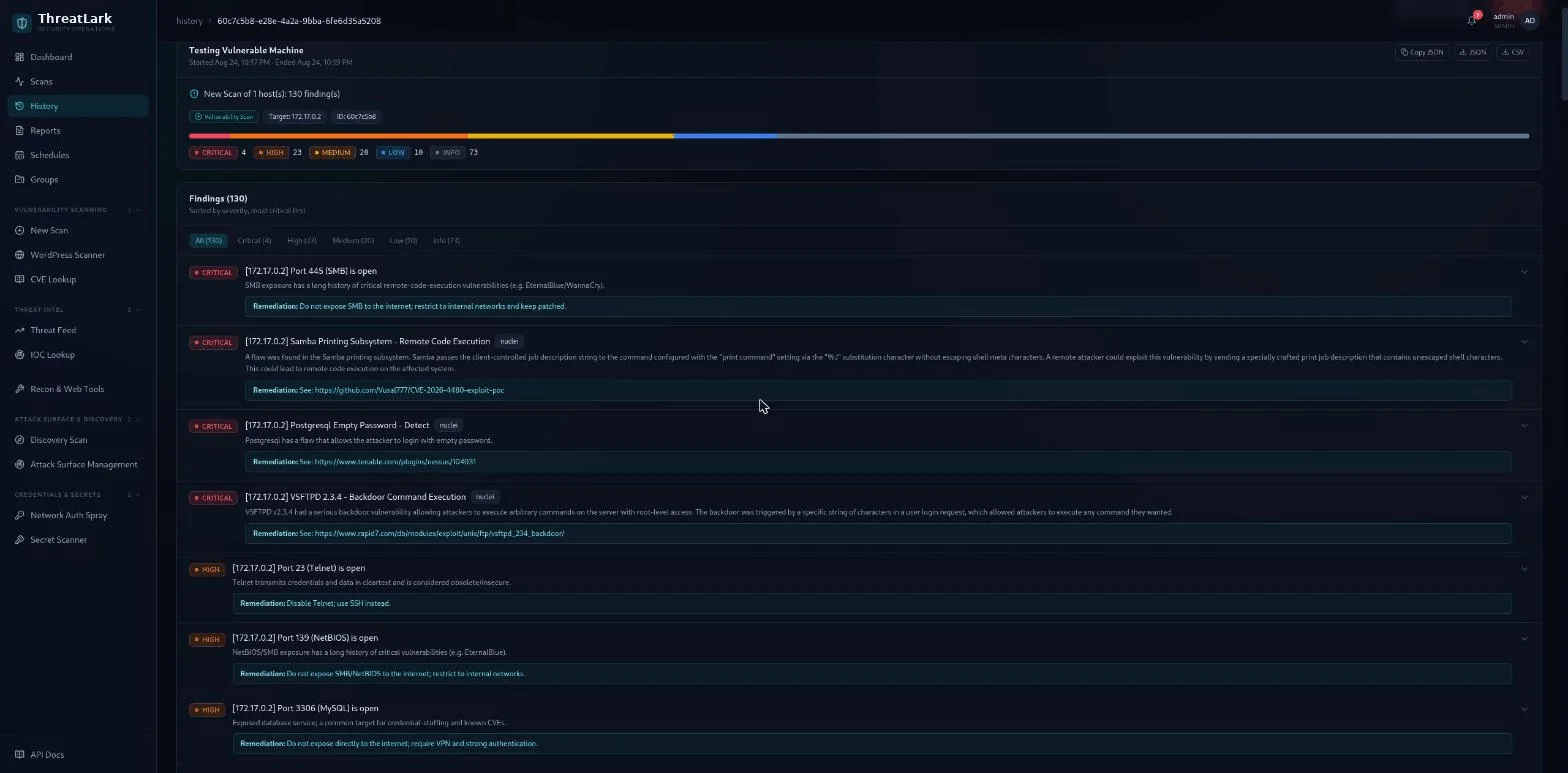
New Scan consolidates core web checks, content discovery and an optional chain of open-source scanners into one run, one report and one set of findings.

  • Core web checks: headers, TLS, technology detection (with outdated/EOL heuristics), CORS, HTTP methods, open redirect and XSS
  • Content discovery with wildcard/soft-404 baselining to suppress false positives, an optional recursive mode and custom wordlists
  • Injection engines: dalfox for reflected/DOM XSS and sqlmap for boolean, error, UNION and time-based SQL injection, run over parameterized URLs found by crawling and web-archive lookups
  • nuclei with the full template set (or targeted categories), always excluding templates tagged DoS or intrusive; retire.js for known-vulnerable client-side libraries
  • specaudit finds an exposed OpenAPI/Swagger spec and replays documented endpoints unauthenticated, flagging broken authentication
  • Subdomain, DNS-takeover, S3 bucket, CDN-aware port scan, web cache, request smuggling, 403-bypass, secret and screenshot stages
  • Normal, Deep and Comprehensive presets; optional anti-WAF mode using a real browser TLS fingerprint
  • Findings that several tools raise for the same class, host and parameter are merged into one corroborated entry
threatlark / history / scan
ThreatLark scan result with findings grouped by severityExpand
Scan results with severity tabs and remediation
Web, API & containers

Purpose-built scanners for specific targets

Each runs as its own tracked job, with its own schedule, results and reports.

WordPress Scanner

Twelve modules: fingerprinting, plugin and theme enumeration, CVE cross-reference against a local NVD feed, XML-RPC, REST API, user enumeration, auth security, file exposure and plugin/theme deep dives. Intrusive checks are off by default.

API Security Scanner

Read-only audit of REST and GraphQL APIs: headers, CORS, methods, rate limiting, GraphQL introspection, verbose errors, a 108-path exposed-endpoint catalog and OpenAPI spec audit with optional two-identity BOLA testing.

Container Scanner

Trivy-powered CVE scanning of container images (OS packages and application dependencies, layer by layer) with severity and fix-available filters. Findings feed the same prioritization.

Credentials & secrets

Find weak and leaked credentials before attackers do

Network Auth Spray

Multi-protocol credential auditing for internal infrastructure: SMB, SSH, WinRM, FTP, RDP, VNC, NFS, LDAP, rsync, TFTP and SNMP. Per-attempt delay and jitter, attempt caps and an SMB lockout threshold keep audits from locking real accounts; an optional password-reuse check pivots a confirmed credential across protocols.

Secret Scanner

Scans the full commit history of git repositories for hardcoded credentials with hundreds of provider detectors, optionally verifying candidates live against the issuing provider. Entropy-based detection and a “verified only” mode are available; findings carry a redacted preview.

Threat intelligence

Know what is being exploited, and whether it affects you

Intelligence features enrich findings and surface emerging risk alongside your scan results.

  • CVE lookup against the National Vulnerability Database by CVE ID or product/version, with CVSS scoring and CISA Known-Exploited-Vulnerabilities flags
  • IOC lookup cross-references indicators with VirusTotal, AbuseIPDB and AlienVault OTX when API keys are configured
  • ThreatPulse pulls CVEs from threat-research sources (Rapid7, CrowdStrike, Mandiant, Unit 42, Picus, The Hacker News), de-duplicates them and can match them against an imported software inventory (Relevant, Possible, Not applicable)
  • A background auto-scan (default every six hours) can alert Slack, a webhook or email when a new CVE matches your inventory
  • A continuously updated Threat Feed of recently published and exploited CVEs for situational awareness

Enrichment sources

  • NVD
  • CISA KEV
  • EPSS
  • Exploit-DB
  • Metasploit
  • VirusTotal
  • AbuseIPDB
  • AlienVault OTX
  • IPinfo

External API keys are optional and encrypted at rest; tools fall back to free tiers or degrade gracefully when a key is absent.

Findings & prioritization

A documented score that puts the fix-first issues on top

Raw tool output is de-duplicated into findings, one row per distinct issue, so re-running a scan updates what you already track instead of piling up duplicates.

  • Priority score (0-100): severity base plus +30 for CISA KEV, up to +15 from EPSS, +10 for a public exploit, +8 for exposure-tool findings and an adjustment for asset criticality
  • Bands: Urgent (70+), High (45-69), Moderate (20-44) and Low
  • CVEs are enriched in the background from a local NVD feed with CVSS, KEV membership, EPSS and a best public exploit link
  • Triage lifecycle with assignee, notes, first/last-seen, reopened and validated timestamps; a Validate action re-tests supported findings
  • SLA due dates by severity (defaults: 7, 30, 90 and 180 days for critical, high, medium and low) with overdue tracking
  • Per-asset risk rollup with crown-jewel, high, normal and low business criticality

Fix-first priority score (0-100)

Severity baseup to +40
CISA KEV (exploited)+30
EPSS probabilityup to +15
Public exploit exists+10
Exposure tool (OT, auth spray)+8
Asset criticality-12 to +20

Export formats

  • PDF
  • HTML
  • CSV
  • JSON
  • SARIF 2.1.0
Bar lengths are proportional to each term’s maximum weight in the documented scoring model.
Dashboards & reporting

Board-ready numbers and engineer-ready exports

Dashboards, program metrics and reports all draw on the same findings, so the numbers agree everywhere.

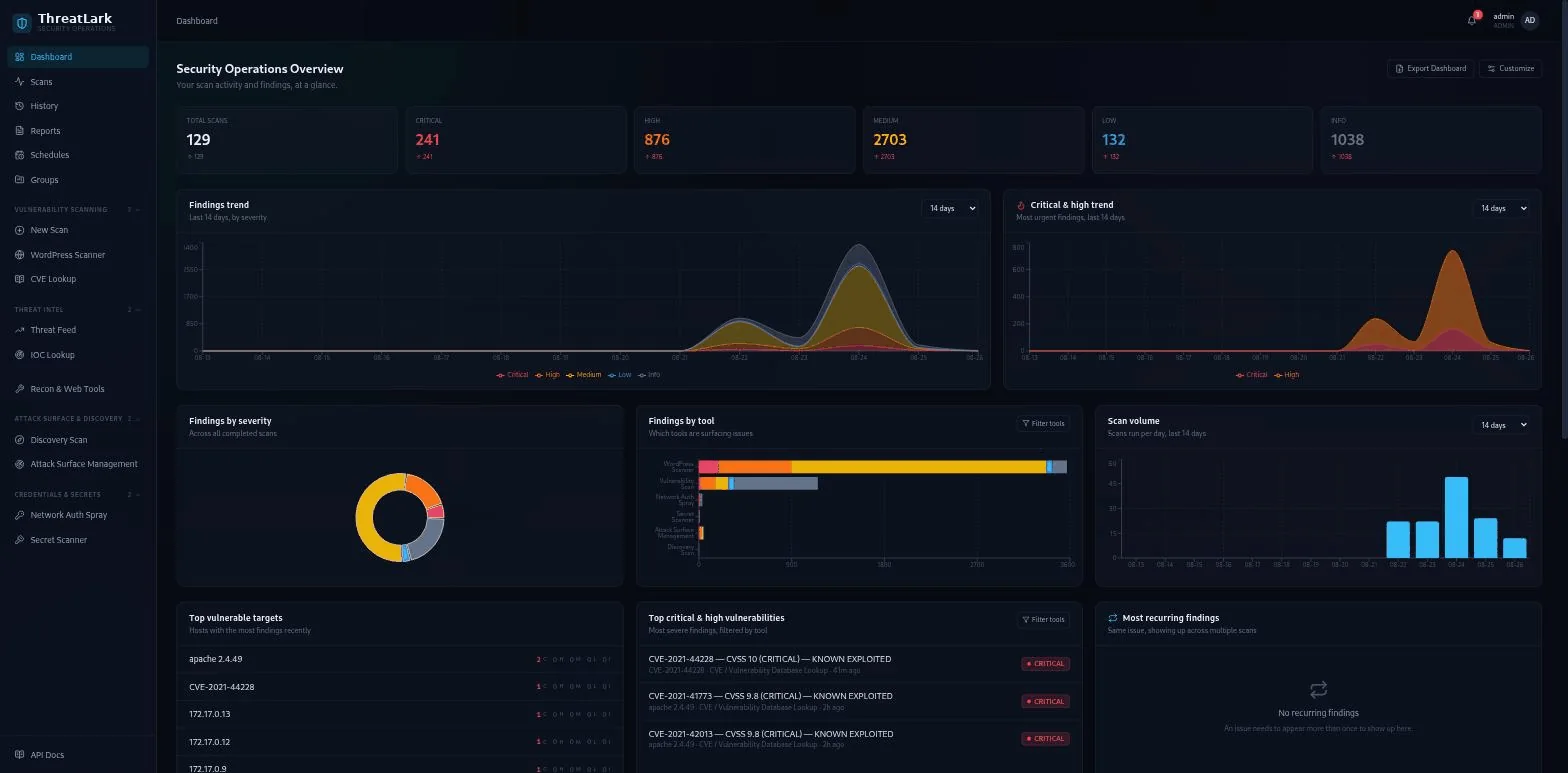
  • A customizable Security Operations Overview dashboard with severity trends, top vulnerable targets, most recurring findings and per-tool breakdowns
  • Program metrics: mean time to resolve, SLA overdue counts, finding aging and an opened-versus-resolved trend
  • Per-scan reports as HTML (self-contained, zero external requests), PDF, CSV and JSON; reports survive deletion of the source scan
  • One-click executive-summary PDF of the dashboard
  • SARIF 2.1.0 findings export for code-scanning dashboards, DefectDojo and CI
  • Discovery Scan reports show host coverage instead of a meaningless severity breakdown
threatlark / dashboard
ThreatLark Security Operations Overview dashboardExpand
The Security Operations Overview dashboard
Automation & workflow

Fits the way security teams actually work

Scheduling

Run any scanner once or on a recurring cadence (minutes to months), timezone-aware.

Target groups

Reusable named host lists, shareable with specific users, usable across every scanner.

Notifications & alerts

In-app notifications, plus optional Slack, webhook and email (SMTP) alerts per event type.

Browser extension

Tech-detect, SSL/TLS, port, WHOIS and CVE lookups for the current tab, through your signed-in session.

16 recon tools

Subdomains, ports, SSL/TLS, certificates, DNS, WHOIS, IP info, headers, tech, URLs, content discovery, CORS, CVE and IOC.

API & docs

Everything the UI does goes through a documented HTTP API, browsable in-app at /api-docs.

See ThreatLark in action

Book a walkthrough and see discovery, exposure scanning and prioritized findings running on your own network ranges.

Request a demo